As a public policy graduate student, I have always been fascinated by the intersection of public policy creation and its management or implementation. This summer, I had the opportunity to see these two worlds collide.
Inside the U.S. Senate: GA Patrick’s Behind-the-Scenes Experience
By Patrick Riley, Graduate Assistant
Public service is often talked about in big, abstract ways, but my summer internship in Senator Chris Murphy’s office in 2024 showed me what those ideas actually look like when they’re lived out day to day. Politics isn’t a distant, one‑dimensional world. It sits right at the intersection of people, communities, and the issues that shape their lives. This internship gave me the chance to step into that intersection of people, communities, and the issues, and see what “serving the public” really means. Continue reading
Alumni Spotlight on: Laura Cahill
What is your current position?
Retired
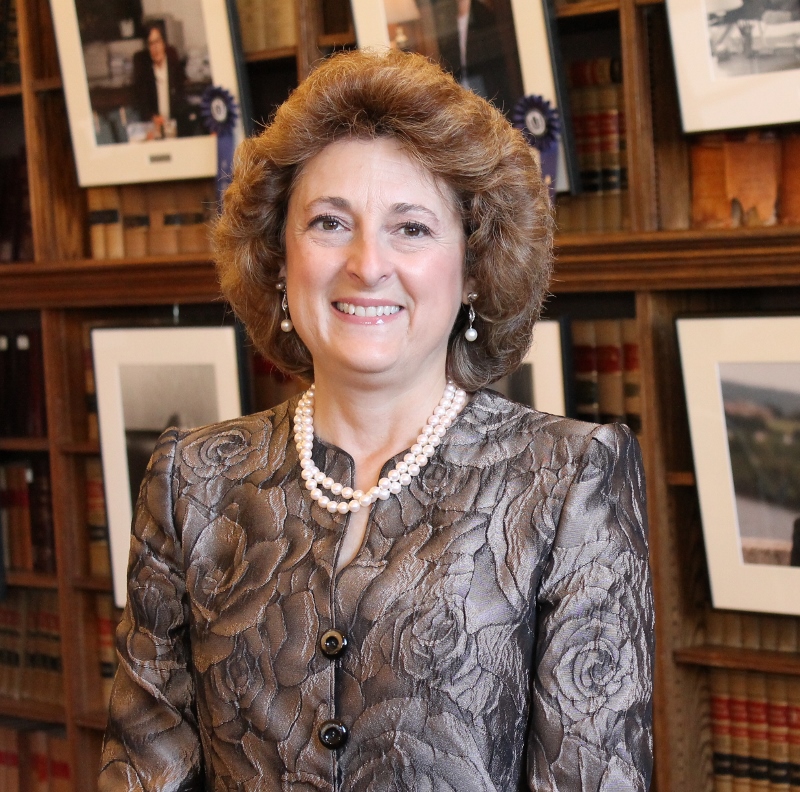 Where did you go to law school? How did you choose that school?
I graduated from UConn Law School Class of 1984. I attended UConn Law School because of its academic reputation and extremely affordable cost. I paid $1,000 tuition/semester = $2,000 tuition/year. The education and cost value were validated based on my professional career.
What year did you graduate from law school? 1984
UConn Experience
Major: Juris Doctorate
How did your major help you prepare for law school and for practice?
I received a B.A. in Political Science from Boston College Class of 1981. The Political Science degree enabled me to become a better writer, resolve problems, find solutions, and think outside the box. This degree was intellectually challenging and when counseling current college students, I advise that a career in law is not one’s only post-college job opportunity.
Law School Experience
What programs did you participate in during law school?
- Moot Court Board
- Appellate Court Clinic
Were you active in any student groups? Which?
Student Bar Association
Did your involvement with those specific programs or organizations help you in your career path or in any other ways?
The Appellate Court Clinic and my job at Legal Aid of Greater Hartford inspired me to pursue a career in public service.
What is one piece of advice you wish someone had given you before law school?
To take a few year off between college and law school. and how to financially manage the break. I would have been more mature and able to handle the academic work load. I could not take time off between college and law school because of undergraduate student loans that would come due, lack of family financial support, and the fear that if I returned home my family would pressure me to stay and work in the family liquor store business or some other mundane secretary/administrative job. I was first generation in my family to attend college/law school. I did not take a break and finished college/law school in seven years with a heavy student debt load.
Work Experience
Describe your practice setting.
Federal Government – U.S. Senator Joseph I. Lieberman
Area(s) of practice.
Other Deputy State Director & Counsel – Managed Six Member Casework Team
How did you choose this area of law?
My areas of casework expertise were tax, immigration, asylum & human rights, foreign affairs, small business, Federal Emergency Management Agency (FEMA), student loans, Native American Affairs, US. Senate financial and ethics issues, and federal and state election law. My background as an attorney were suited to handle these complex federal and state issue areas.
Is there a typical day? How would you describe it?
There was never a typical day. I was a full time supervisor for the casework team and a full-time caseworker in my issue areas. I staffed Senator Lieberman at Connecticut events, worked in campaigns during election cycles, spoke to constituents to resolve their federal and state problems, designed the senate office space and negotiated the lease agreements, advised the Democratic State Party on campaign finance law, attended constituent meetings representing Senator Lieberman, and managed approximately 4,000 casework problems on an annual basis. I read every letter and email, and signed off on every casework letter that went out under Senator Lieberman’s or a caseworker’s name.
How many hours per week do you work? What is your schedule?
I typically worked 50-60 hours/week. During campaign elections, I worked 80-100 hours/week.
Describe your work/life balance.
Too much time spent in the office. Finally during Senator Lieberman’s last term (2006-2012) I worked a regular 40/week schedule. My last year of senate employment, I worked only three days/week.
What do you like most about your job? What would you change?
My skill set is being a problem solver, negotiator and mediator. I received tremendous professional satisfaction solving constituent problems that were life-changing for many people. My work had value and every day felt new and exciting. The only thing I would have changed was the heavy work hours.
If you couldn’t be a lawyer anymore, what would you do? If you had a career before becoming a lawyer, what was it?
I would be a master gardener or a golf professional.
Roughly what is your salary?
My starting salary after law school was $25,000/year. My ending salary when I retired in 2012 was $96,000/year.
Roughly, how much are you student loan payments?
$236/month. One never forgets.
How long do you expect to be paying your student loans?
I paid student loans from 25 years of age until 37 years of age (12 years) when I was finally financially able to make a final balloon payment and end the student loan nightmare.
Have your student loans impacted your career choices or other life choices in any way? How?
Yes. My first job after law school was Tax Attorney at Arthur Andersen & Company for 3 1/2 years @ $25,000/year. I could not afford to pursue a career in legal aid because of the lack of jobs and salary.
Just for fun: If you could have dinner with any lawyer, real or fiction, living or dead, who would it be and why?
President Thomas Jefferson was a lawyer and Renaissance man in the depth and breath of his interests. As one of the Founding Founders of our nation, it would be extraordinary to her Jefferson’s own words about the meaning of the Constitution and Declaration of Independence, the Revolutionary War, the political alliances made to ensure a young nation survived, his ownership of slaves, etc. President John F. Kennedy noted at a gathering of 49 Nobel Prize recipients at a White House dinner on April 29, 1962 – “I think this is the most extraordinary collection of talent, of human knowledge, that has ever been gathered at the White House – with the possible exception of when Thomas Jefferson dined alone.” Jefferson was a man of great contradictions yet to this day remains remembered not for being a lawyer but a Founding Father.
Law School Fair 2016
UConn Mock Trial Wins Awards at Regional Competition
Earlier this month, UConn Mock Trial competed in the regional tournament at Yale University. While they did not advance to the next round of competition, the team was awarded the Spirit of AMTA Award for best displaying the ideals of honesty, civility and fair play. Additionally, Brendan Costello, was awarded one of the Outstanding Attorney Awards.
UConn Mock Trial continues to impress!
UConn Moot Court Team – National Competition Update
On January 17th and 18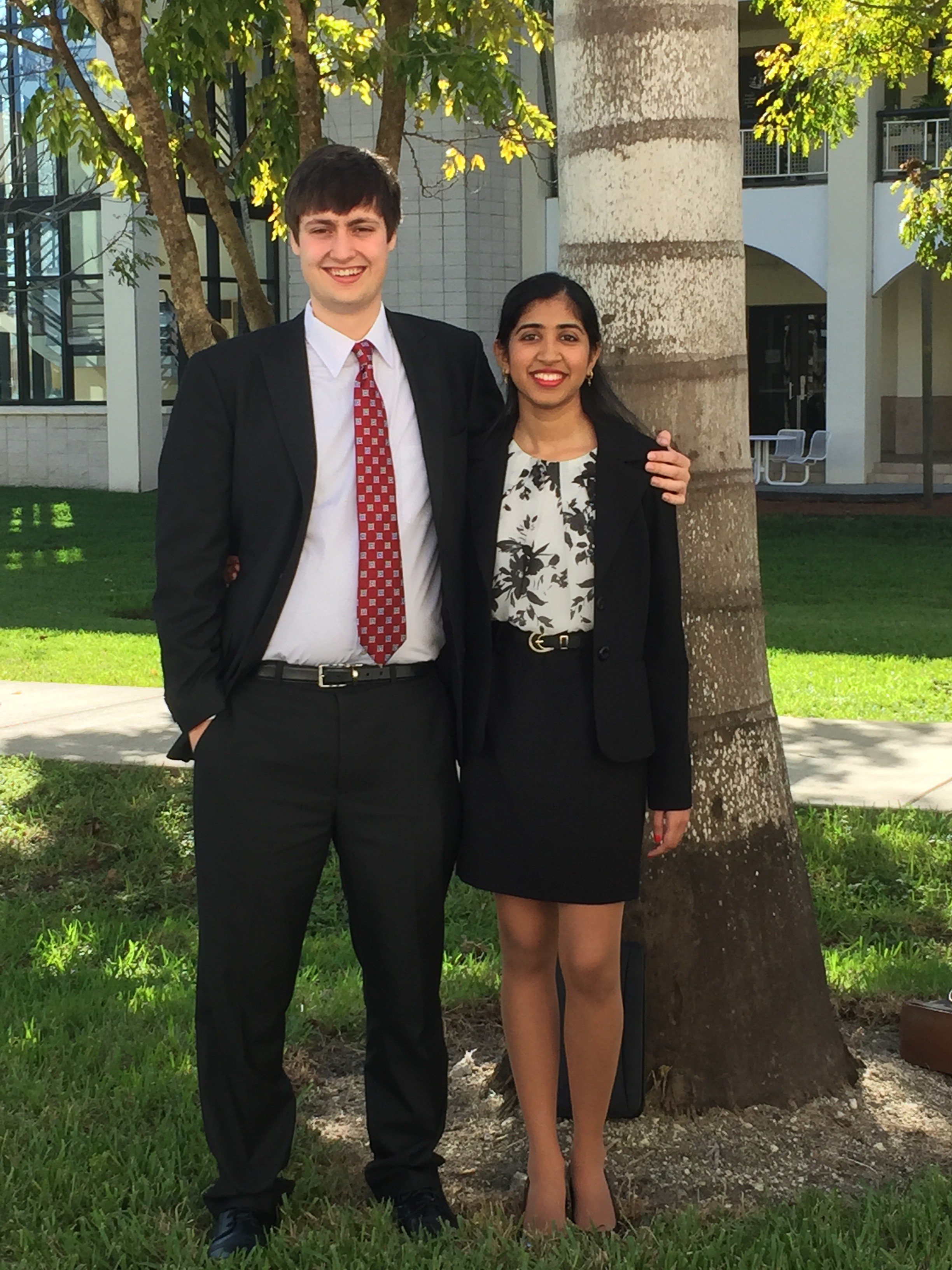 th, UConn Moot Court competed in the National Tournament for the American Collegiate Moot Court Association at Florida International University College of Law in Miami Florida. Each team consists of two students who argue both sides of a Supreme Court case before a panel of judges. This year, Luke LaRosa and Snigdha Mamillapalli represented UConn at the National Tournament.
To earn a spot to the National Tournament, teams must first compete in a regional tournament. The top scoring teams from each regional competition advance to the National tournament. Nearly 400 teams competed throughout the various regional competitions. Only 80 were invited to the national tournament.
For the first day of competition, teams compete in three rounds, against three different teams. At the close of the first day of competition, UConn was one of only 6 teams undefeated. 45 teams, including UConn advanced to the second day of competition. We were, unfortunately, eliminated in the second round of competition on Saturday. Our team ranked among the top 32 teams at the tournament. I am incredibly proud of their performance and dedication throughout the entire competition season.
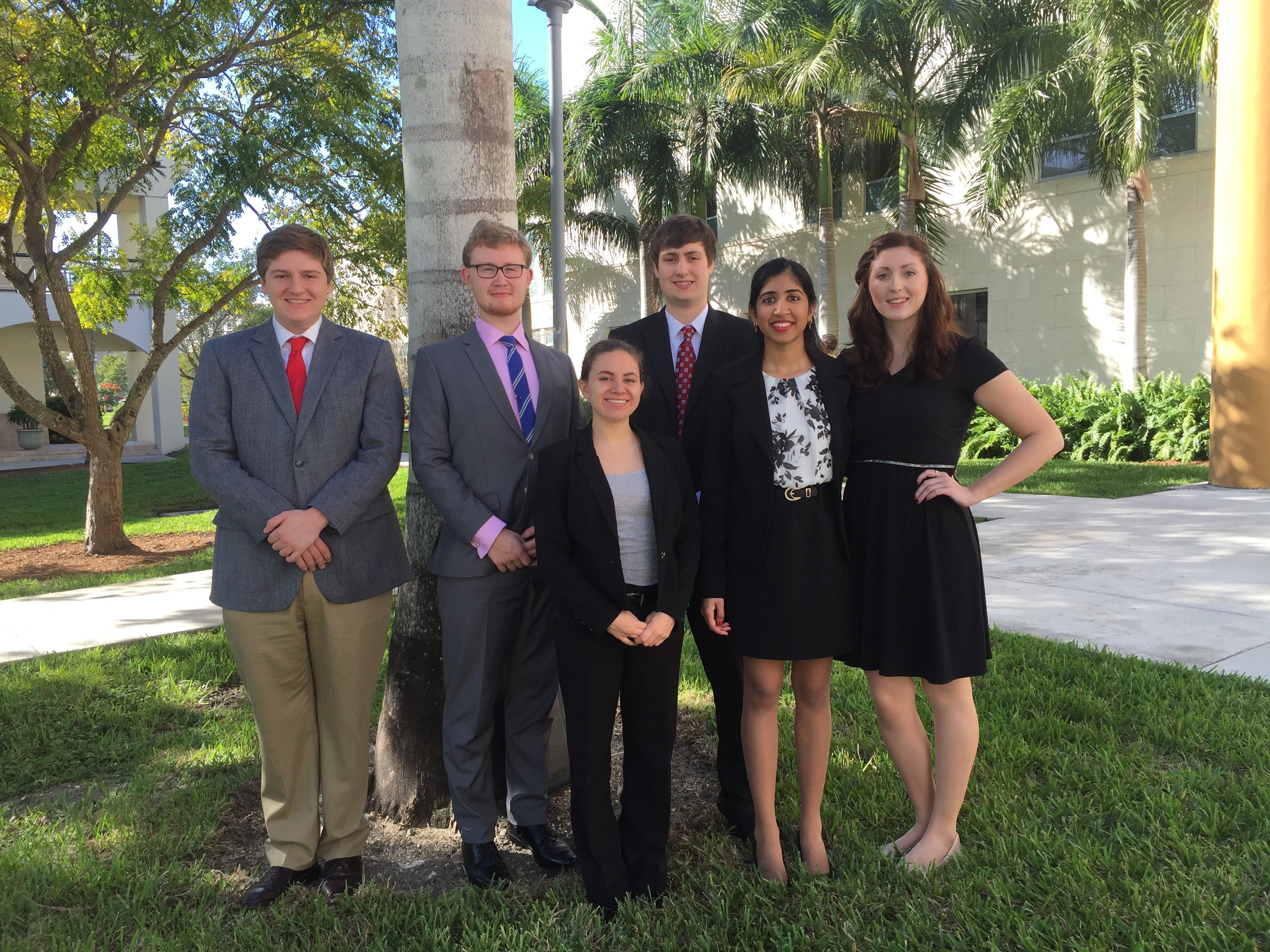
In addition to the two students competing, several other members of the UConn Moot Court Team traveled to Miami to help cheer on our competitors. These students were the highest scoring UConn students at the regional competition in November who did not advance to the national tournament. They were a huge help to Luke and Snigdha as they prepared for the national competition.
Looking forward to next year’s competition season!
If you’re interested in finding out more about Moot Court, look for them at the Involvement Fair or find them on UConntact!
UConn Moot Court Featured on UConn Today!
Check out the coverage of UConn’s undergradute moot court team from UConn Today! Check back later in January to find out how the team did at the National Competition!
UConn Moot Court Advances to Nationals!
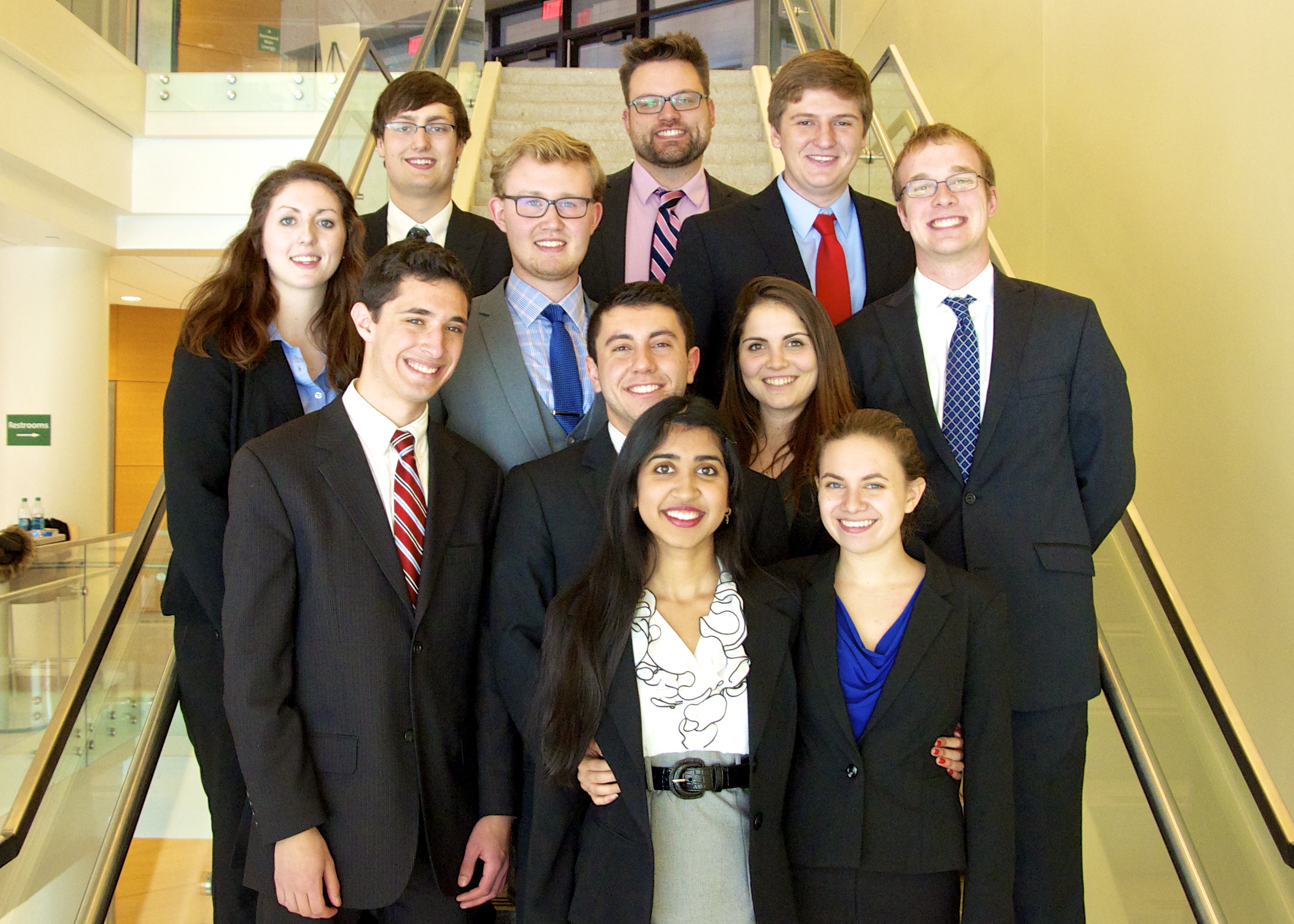
In 2013, UConn students worked with Pre-Law advisor Dr. Edward F. Kammerer, Jr. to launch an undergraduate UConn Moot Court Competition team, and in only its second year, a team of two students has earned a spot in the national competition at Florida International University College of Law this January 2015.
Luke LaRosa ’16 (CLAS) and Snigdha Mamillapalli ’16 (BUSN) are junior Honors students and members of the Special Program in Law. They are one of five teams (of two) that UConn sent to the Eastern Regional qualifying competition this past November in Fitchburg, Mass. In addition to his place at nationals, LaRosa also earned a “Top Orator” honor, which is awarded to the top ten debaters. He placed fourth out of the 124 competitors.
Fellow UConn Moot Court team members are Santorini Rivera ’16 (CLAS), Christopher Baker ’16 (CLAS), Leon Peschel ’16 (BUSN), Katie Cavanaugh ’17 (CLAS), Danielle Ullo ’17 (CLAS), Alexander Loukellis ’17 (BUSN), Ryan Norton ’17 (CLAS), and Jared Quigley ’18 (CLAS), all Honors students. These UConn undergraduates debated against more than 120 students across the region in Fitchburg. Many of these students were also part of Moot Court in its first year, including LaRosa and Mamillapalli.
While Moot Court competitions are common in law school, they are growing in popularity at the undergraduate level. “Moot Court teaches legal reasoning, but it also stresses critical analysis, public speaking, and flexibility,” says Kammerer. “A student may have a perfectly rehearsed speech, but a judge will interrupt at any moment, even mid-sentence. A team prepares for this by thoroughly understanding every aspect of the case and the arguments. Students cannot be tied to planned arguments. The judges’ questions require students to adapt their arguments to those questions. It takes skill and quick thinking, combined with knowledge of the case and the law to succeed during Moot Court.”
Each year, the mock appellate court case alternates between civil and criminal. This year’s Moot Court issue was abortion. Cases are generally hot topics intended to pique students’ interest and keep them engaged throughout the rigorous preparation. During the tournament, each member of the two-person team debates different precedents of existing case law, as they present originally crafted arguments related to the same issue. The UConn Moot Court team practiced weekly during the semester, and almost daily in the last days leading up to the competition. During the tournament, each team member has ten minutes to present his or her argument.
“Moot Court is a lot of work, but its benefits extend well-beyond the competitions,” says LaRosa. “I’ve been able to apply the skills I’ve learned to other courses and projects, including those not legally oriented. Moot Court helps me, and I think all of us on the team, think more critically about how we construct arguments on any topic.“ LaRosa is originally from Central Vermont and has interests in regional planning, land use law, and public policy. He is majoring in Urban and Community Studies as well as Geography, and is also a member of the Master’s in Public Administration Fast-Track Program. In addition to competing with the UConn Moot Court team, LaRosa works at the UConn Writing Center, interns with the Connecticut State Data Center, and is currently engaged in research regarding urban neighborhood development in Hartford. He was also a 2013 Holster Scholar and was recently named a member of the competitive Leadership Legacy Experience program. LaRosa’s career goals include working in regional planning with an emphasis in land use law and policy.
Mamillapalli is a Connecticut resident who majors in Management Information Systems and Philosophy. She is a resident assistant, a mentor with Peer Allies Through Honors student group, and secretary for UConn Change Lives (which raises money for children in Bangladesh, Nepal, and India). She has earned various scholarships, held several internships (including those in the legal field), and speaks multiple languages. Mamillapalli plans to attend law school after completing her undergraduate degree. “What first interested me about Moot Court was the opportunity to develop my public speaking skills while focusing on constitutional issues. There’s nothing quite like getting up in front of a panel of real judges and attorneys, and having them interrupt and question the argument you’ve developed for months. It’s definitely a challenge and a thrill that has advanced my critical thinking skills,” says Mamillapalli.
The UConn Moot Court team is a Tier II student organization, receiving partial funding through USG. Membership is open to all undergraduate students. The team hopes to send several students to the national tournament event in Miami this January to support LaRosa and Mamillapalli, but also to continue the lessons learned from the Moot Court experience.
The tournament is hosted by the American Collegiate Moot Court Association.
UConn Pre-Law Event on Military Law
As part of our Lunch with Lawyers series, we recently hosted two lawyers who work for the United States Army.
Alumni Spotlight on: Ashley Ludovicy, Class of 2005 and 2006
 What is your current position?
Assistant Chief of the Career Program for the Army’s Legal Career Program.
What year did you graduate from UConn? 2005, BS in Business, 2006 BA in Classical Languages
Where did you go to law school? How did you choose that school?
New England School of Law. When I was looking at law schools, I knew I wanted to stay in the Northeast and at an accredited university. I took the LSATs with a less than stellar result but had good grades at UConn. I was accepted to a school in California, Albany Law School and New England. New England was in the center of Boston and I wanted to live in a city.
What year did you graduate from law school? 2009
UConn Experience
Major: International Business and Classical Languages
How did your major help you prepare for law school and for practice?
When I was in law school, I wanted to study International Law. Luckily I took most of the courses or preliminary courses at UConn so I felt more comfortable in the work I was doing. Also, I took eight years of Latin, which was not necessary, but helped decode some legalese in my reading assignments.
What organizations and activities (e.g., clubs, sports, study abroad) did you participate in while at UConn?
Delta Sigma Pi, Study Abroad (Paderno del Grappa), Colleges Against Cancer (Relay for Life and the Cancer Society) and the Classical Languages Fraternity.
What jobs or internships did you have while at UConn?
I worked with Sodexho (at the concession stands) during the year, along with the Career Placement Office in the Business School. I also did an internship with Casey Fuel in CT for my small business class. I also worked at the library during my first few semesters in the circulation and map departments.
Did you take any time off?
No.
What is one piece of advice you’d give to a current UConn student?
I would suggest picking a major that you love! When students say they are studying pre-law or political science, unless that is their passion, it is unnecessary. Law school will teach the law, study what moves you. You can then translate those skills and that knowledge into a legal career later since almost everyone and every topic needs an attorney. Also, the more you love a subject, the more work you will do in that class and the better your grade (which is really the way that you are getting into law school). If you can start your legal career in college by taking classes in compliance or regulations, I would! Being more familiar with law allows you the freedom in law school to take a course that you might not have thought of.
I would also STUDY ABROAD! I was lucky enough to study abroad in law school again between jobs, but not everyone has that luxury. Most law students take internships between their two summers so they do not have the ability to pick up and go to another country. If you know that you want to attend law school, start networking now so that you can get the job in that law firm or office before you start law school. Also, get a start on the LSATs. I know I waited until my last year and I was “stuck” with my poor LSAT score.
Law School Experience
What programs did you participate in during law school?
I was a law student at night so I worked during the day, clerking at a local firm.
During my first two years of law school, I worked as a recruiter for a local masters program and then my final two years at a medical malpractice law firm. I studied abroad in Malta and was part of Phi Alpha Delta.
Were you active in any student groups? Which?
Phi Alpha Delta
Did your involvement with those specific programs or organizations help you in your career path or in any other ways?
No, they did not. However my career was not a traditional one. I met my husband in law school and he was commissioning in the Army that following year. I followed him to DC and found a job with the Army as a civilian.
What is one piece of advice you wish someone had given you before law school?
Work your hardest and get the best grades you can, but NETWORK NETWORK NETWORK. Even if you cannot get a job through that network, you will feel less alone in your job search.
Work Experience
Describe your practice setting.
Government Agency (US Army)
Area(s) of practice.
Administrative,Civil Litigation,Consumer,Family Law,Personal Injury,Torts,Tax,Trusts & Estates
How did you choose this area of law?
It choose me through my marriage with my husband. In the Army, we do a little bit of everything to prepare our soldiers for deployment.
Is there a typical day? How would you describe it?
I am the Assistant Chief to the Army’s Legal Career Program. The Army created Career Programs to train and retain their civilian employees. I also work under the Labor & Employment Office where I maintain the military spouse resume database. It is a new initiative to attempt to place military spouses in open legal positions within the Army. Due to my wide range of tasks, every day is different. Today I have been preparing for our yearly conference where we will decide what type of training is necessary for our workforce and how we can obtain those goals with our budget. Tomorrow I might be on a teleconference with spouses to see how their skills would fit the needs of the Army.
How many hours per week do you work? What is your schedule?
Around 50 – our hours of operation are 730 to 430.
Describe your work/life balance.
Currently my husband is stationed at Camp Casey, Korea so my balance is skewed with more work than life. After work, I normally attend an attorney function sponsored by the Army, Congress, the American Bar Association or my local bar association, Military Spouse JD Network. The weekends are meant for catching up with work and household chores.
What do you like most about your job? What would you change?
I would not change a thing. Every day is a new challenge and has different clients/topics in it. I could not be happier (or prouder) to work for the U.S. Army.
If you couldn’t be a lawyer anymore, what would you do? If you had a career before becoming a lawyer, what was it?
I would become a career counselor. I loved counseling students at UConn in the business placement office and I enjoyed it when I worked for the masters degree program. I mentor young attorneys now so it would be a natural transition for me.
Roughly, how much are you student loan payments?
$1000
How long do you expect to be paying your student loans?
For the full 20 years that are required (or possibly ten if I qualify for the Public Service Student Loan Program).
Have your student loans impacted your career choices or other life choices in any way? How?
They have not, I have been rather neglectful of my student loans otherwise they will tear you down and make you question your life choices. There is enough uncertainty in the U.S. Army lifestyle so as long as I can make my payments, I keep moving along.
Just for fun: If you could have dinner with any lawyer, real or fiction, living or dead, who would it be and why?
One of the supreme court justices (any one!) – their decisions were such a large focus in law school and have such a bearing on our lifestyle choices that I would love to pick their brain. Not to mention, who doesn’t want to be a Supreme Court Justice themselves?